English language grammar

Showing posts with label Writing. Show all posts

Wednesday, March 15, 2017

Grammar: Present Perfect Simple

Present Perfect Simple


Forms

Principal uses
  • ·         To refer to a time period which is not yet finished (e.g. today, this month):
          We've bought a new house this week. (an incomplete period)


  • ·         To show that something happened in the past. We don't state when is happened:
          I've lost my watch. Have you seen it anywhere?
          Note: If we give the time we must use the simple past:
          I lost my watch yesterday. (not I've lost my watch yesterday)
         The following time expressions are often used: ever, never, always, up to now, so far.
         This is the worst storm we've ever had. (at any point before now)

  • ·         To talk about a situation which started in the past and usually continues after the time of speaking in the present:

He has lived here for six years. (He has lived here till now)
We use for with a length of time (e.g. for three weeks, for two days, for six years) and since with a point in time (e.g. since 2010, since Wednesday, since nine o'clock, since I was five, since I moved here)
  • ·         To talk about an action which occurred at an unstated time in the past, provided that there is still a connection with the present:
          I’ve collected all the documents that are needed for the house sale. (I have the documents now)

     Note: If we give the time we must use the simple past:
     I lost my watch yesterday. (not I've lost my watch yesterday)


Commonly used expressions

  • ·         recently, just, already, and yet with negatives or questions.
               I've just arrived.
               Have you done your homework yet?


Note the position of the following time expressions that occur with the present perfect:
  • ·         between the auxiliary and main verb (e.g. recently, already, always, ever, just, never):
               I've already bought my ticket.               I’ve never met your brother.

  • ·         Ever is generally used with questions or negatives:
               Have you ever been to London?
  • ·         After the main verb (e.g. all my life, every day, yet, before, for ages, for two weeks, since 2001, since I was ten etc.)
               I haven't seen him for ages.               I’ve known John since I was ten.


  • ·                 If there is an object clause, the time expression comes at the end:
               I've read this book every morning since then.               He hasn't ridden since he broke his arm.
 ---------------------------------------------------------------------------------------------------------------------------------
If you like this content, share it. 

Don't forget to make sure to be notified with our new posts, follow us by entering your email address in the required field on the top of  the right column

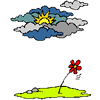
Grow your vocabulary : talk about the weather


Using verbs to describe the weather

sunny
The sun is shining
drizzle
It's drizzling
windy
The wind is blowing
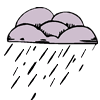
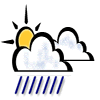
rainy
It's raining (The rain is falling.)
hail
It's hailing
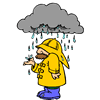
pouring
It's pouring (The rain is pouring down.)
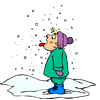
snowy
It's snowing (The snow is falling.)
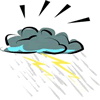
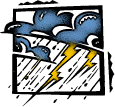
storm
It's thundering


Using adjectives to describe the weather


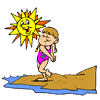
scorching
Sweltering = It's sweltering. or It's a sweltering day.

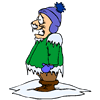
freezing
Freezing = It's freezing. or It's a freezing day.

warm
Warm = It's warn. or It's a warm day.

cold
Cold = It's cold. or It's a cold day.

sunny
Sunny = It's sunny. or It's a sunny day.

cloudy
Cloudy = It's cloudy. or It's a cloudy day.

clear
Clear = It's clear. or It's a clear day.

storm
Stormy = It's stormy. or It's a stormy day.

mist
Misty = It's misty. or It's a misty day.

foggy
Foggy = It's foggy. or It's a foggy day.

breezy
Breezy = It's breezy. or It's a breezy day

windy
Windy = It's windy. or It's a windy day.

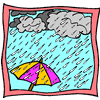
showery
Showery = It's showery. or It's a showery day.

rainy
Rainy = It's rainy. or It's a rainy day.

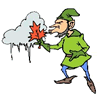
jack frost
Frosty = It's frosty. or It's a frosty day.

snowy
Snowy = It's snowy. or It's a snowy day.

icy
Icy = It's icy. or It's an icy day.

drizzle
Drizzly = It's drizzly. or It's a drizzly day.


sunshine
. Dry = It's dry. or It's a dry day.


wet
Wet = It's wet. or It's a wet day.


If you like this content, share it. 

Don't forget to make sure to be notified with our new posts, follow us by entering your email address in the required field on the top of  the right column

Tuesday, March 14, 2017

IELTS & TOEFL Vocabulary: Talking about Food

Vocabulary

Food


One of the most common topics to talk about in real life is food

Here are some tips about the vocabulary mostly used while talking/ writing about food

Enjoy

Vocabulary: How to talk about ADVANTAGES and DISADVANTAGES

Improve your speaking and writing

How to talk about advantages and disadvantages


You always need to express yourself when asked about advantages and disadvantages.

Here are some very important tips on how to do that effectively.

Enjoy

Sunday, March 12, 2017

English language levels

From A1 to C2, where are you?


Many of those who are seeking to learn the English language quit at the early beginning because they find the available courses either too easy or too hard for them.

Believe me, the problem is not with the course, the problem is the starting point. Many start either at a very amateur level so they feel bored very early or start at a very advanced level so they feel stunned, " I am never gonna move forward, I don't even know what the instructor is talking about".

Well, the very first step you should take when the " learning/Improving English language" decision is made, should be Identifying your level.

The Common European Framework of Reference for Languages (CEFR) came up with a scale (in the picture above) to identify language levels which, by the way, is applicable to all European languages.

And now is the action part, How to do that? well, there are so many tests out there for you to take, but I recommend this one that is provided by the reputed British Council.

Now you know your level, you can start roaming the blog looking for the materials that is right for you, click the Home button to go to the main page, and enjoy your English language mastering journey.

Tuesday, March 7, 2017

Improve Your Writing - 6 ways to compare


English - Improve your writing skills -  6 ways to compare in English

Please share your thoughts in the comments section below

Sunday, March 5, 2017

IELTS - How to get a high score on Task 1 of the writing module - IELTS


Emma from engvid  is giving us very valuable tips on how to score high on task 1 of the writing module in the IELTS test

Enjoy the video and share your thoughts in the comments section below


Friday, March 3, 2017

ACADEMIC WRITING TASK 2


In Academic Task 2 of the Writing module, you are given brief details of an opinion, an argument or a problem, and have to produce an extended piece of discursive writing in response.

For example, you may have to consider an opinion or weigh the pros and cons of an argument before presenting your own view on the matter. You may also have to discuss various aspects of a problem and then outline your ideas for solving it.
Here, Liz from IELTS Liz is showing us how to write an introduction.

And here, the gentleman from aehelp.com is showing us tips and tricks to score high in the academic writing test task 2 over 2 videos


after watching the above, you can find writing test task 2 examples by following the links below:

Hope you all enjoyed the article, videos and the tests, please share your thoughts in the comments section below.

IELTS & TOEFL - How to give your opinion


Emma, from engvid  and a very important talk about the techniques to give your opinion.

This should help on both speaking and writing sections.

Enjoy the video and share your thoughts in the comments section below.